
Antifragile Summary and Review | Nassim Taleb
1-Sentence Summary
Antifragile by Nassim Nicholas Taleb explores how systems, individuals, and ideas not only survive but thrive through chaos and disorder, revealing why embracing volatility is the key to becoming stronger—because what doesn’t kill you doesn’t just make you stronger, it makes you antifragile.
Life gets busy. Has Antifragile been on your reading list? Learn the key insights now. We’re scratching the surface here. If you don’t already have Nassim Nicholas Taleb’s popular book on philosophy, business and economy, order it here or get the audiobook for free on Amazon to learn the juicy details.
Introduction
You have been taught to fear disorder. Yet your muscles only grow because lifting weights damages them, and your immune system only sharpens because germs keep attacking it. Some things need stress the way fire needs wind. That is the thesis of Antifragile: Things That Gain from Disorder by Nassim Nicholas Taleb. This summary covers eight key ideas, from a word no language had to the ancient rule that keeps experts honest.
Who Is This For
This summary of Antifragile is for the founder who lies awake fearing the next shock instead of positioning to profit from it. It is for the investor burned by confident forecasts, and for the parent tempted to bubble-wrap a child. If comfort has been quietly making you weaker, this book was written about you.
StoryShot #1: What Does Antifragile Actually Mean
Picture a box of wine glasses stamped fragile, meaning handle with care. Now imagine the exact opposite: a package stamped please mishandle, holding something that gains from being kicked around. No language on earth had a word for that property, which is strange, because life is full of it. So a word had to be invented.
Most people assume the opposite of fragile is resilient or unbreakable. Wrong, and the error matters more than almost any other mistake in modern thinking. The resilient merely survives shocks and goes back to being what it was. “Antifragility is beyond resilience or robustness. The resilient resists shocks and stays the same; the antifragile gets better.” That gives you a triad, and the triad is the lens for everything that follows. The fragile craves calm and breaks when chaos arrives. The robust endures without changing. The antifragile feeds on disorder and improves. A teacup is fragile. Your immune system is antifragile, at least until you sterilize its whole world. Ask of anything that matters to you what happens when volatility goes up. That single question may be the most durable thing you take from this summary.
Wind extinguishes a candle and energizes fire.
You do not want to hide from the wind, and your body already knows it.
StoryShot #2: Why Stress Makes You Stronger
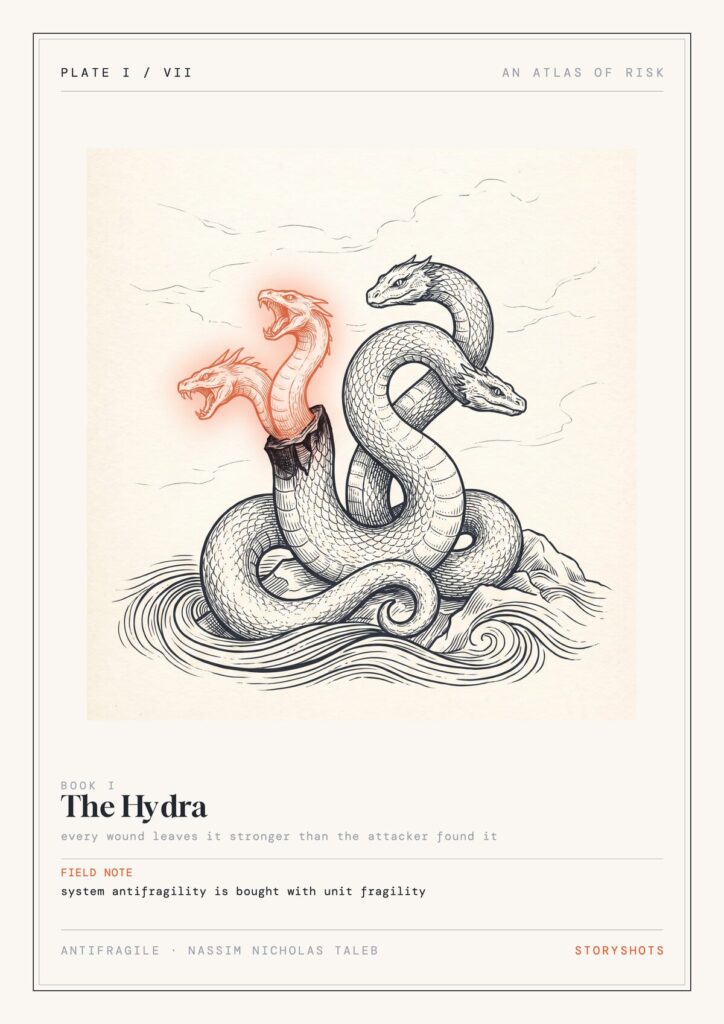
Greek mythology already sorted the triad. Damocles feasts under a sword hanging by a single horsehair, which is fragility. The phoenix burns and rises exactly as it was, which is robustness. Then there is the Hydra. Cut off one head and two grow back. Every wound leaves it stronger than the attacker found it.
Your body already works this way. Lift a weight heavy enough to strain you and the body overcompensates, rebuilding the muscle stronger than the job required. The technical name is hormesis. A small dose of a harmful stressor triggers a response that overshoots the harm, leaving you better than before. An ancient king swallowed small doses of poison until poison could no longer kill him, and what reads like legend is now a principle in toxicology. Efficiency, the god of modern management, is often just fragility wearing a nicer suit. Today, reintroduce the smallest honest dose of difficulty you can stand.
“Difficulty is what wakes up the genius”.
Comfort, it turns out, is the quiet villain, and the modern world manufactures comfort at scale.
StoryShot #3: How Modern Life Makes You Fragile
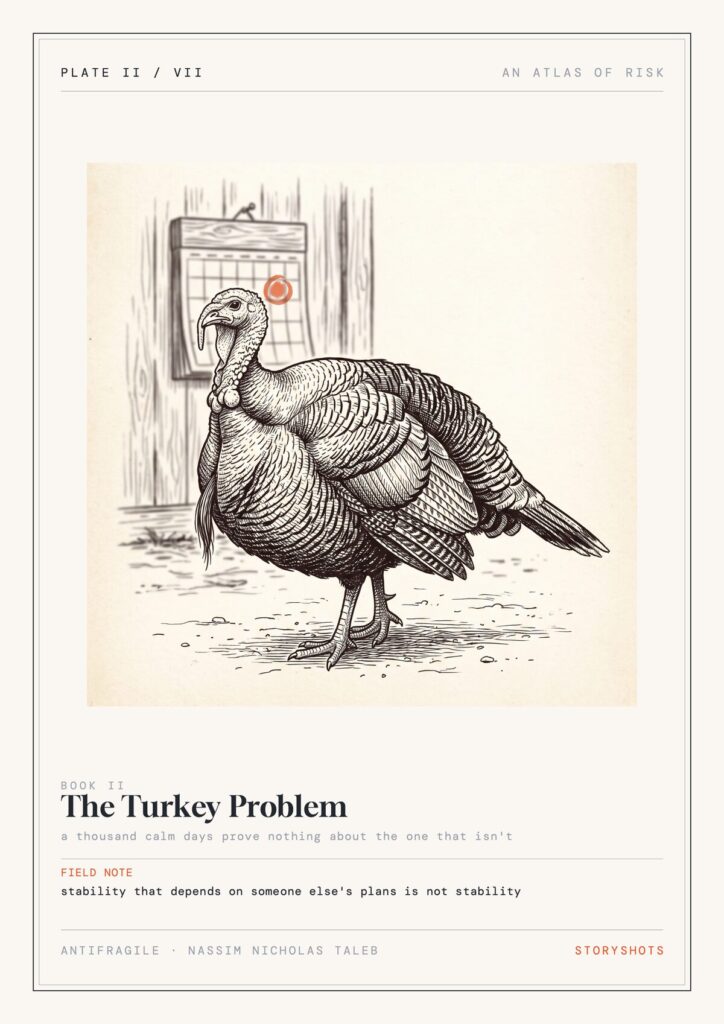
A turkey is fed every day for a thousand days, and every feeding deepens its statistical confidence that humans exist to love it. Its certainty peaks on the day before Thanksgiving. The turkey’s mistake was not a lack of data. It had a thousand consistent data points, and they all pointed the wrong way. Stability that depends on someone else’s plans is not stability. The absence of harm so far is no evidence that harm is absent.
Modern life builds turkeys on purpose. A salary that arrives like clockwork hides one enormous risk, because a single meeting with human resources can cut the income to zero in an afternoon. Then comes the fixer. The fragilista, usually in a suit, fixes things that were not broken and breaks them in the process. Medicine has an honest name for harm done by the healer: iatrogenics. The benefits of intervening are visible and credited to the intervener, while the harms arrive late and get blamed on something else. Before you fix anything this week, ask what happens if you do nothing.
Abundance is harder for us to handle than scarcity.
What remains, when forecasting fails and fixing backfires, is the move the next idea delivers.
StoryShot #4: How to Live in a World You Cannot Predict
The escape is one of the great mental moves in the book. Stop predicting events and start measuring fragility. You can never know which shock is coming. You can always ask what a shock would break. The turkey could not have predicted the date of Thanksgiving, but it could have noticed it was the only party getting fattened for free.
Fragility is visible today even when the future is not. Prediction demands to know what is coming, which nobody can deliver. The classifying question only asks what would break, and a pencil plus an honest hour can settle it. Run it on your income, then on your calendar. Anywhere your comfort depends on a counterparty whose plans you cannot see, you are the bird, and the only reliable fix is a second source of feed. Notice what just happened to your worry list. Fretting about which crisis comes next is optional once you know what each crisis would break first.
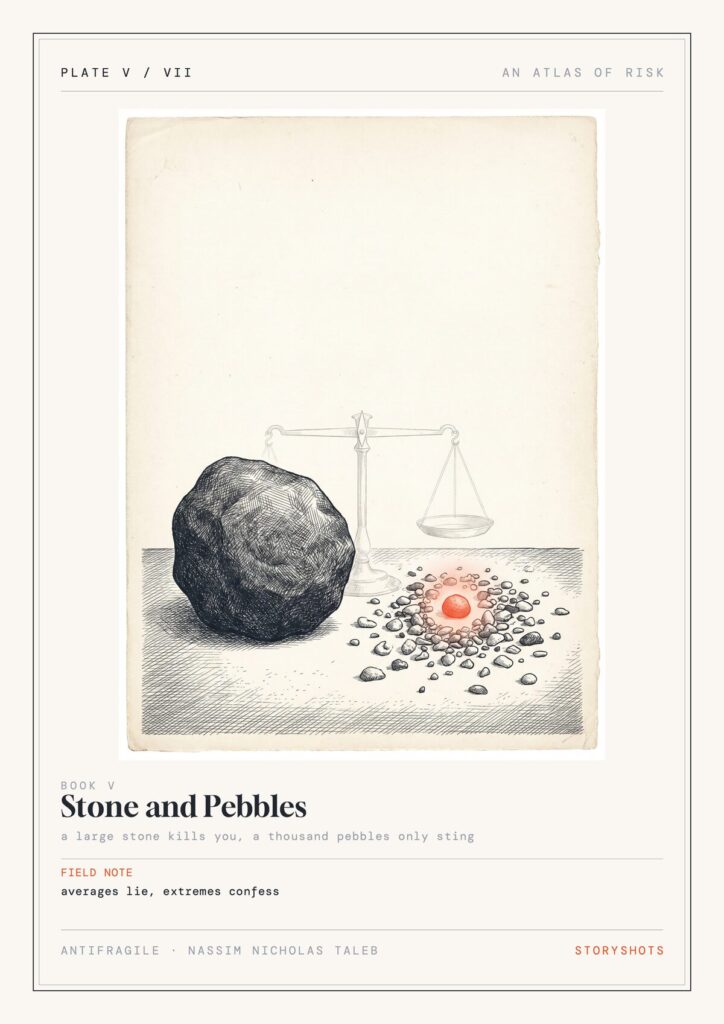
Never cross a river that is, on average, four feet deep.
Averages are how fragile things lie to you. Knowing what would break is half the cure, and the other half is a shape for your whole life that looks like a barbell.
Which of the three columns holds your income right now, and which would you rather it sat in five years from now?
If someone came to mind while you read that, someone who loves ideas that flip the obvious, send them this first half today.
StoryShot #5: The Barbell Strategy Explained
Seneca was among the richest men in Rome and a Stoic philosopher, and he solved the problem before anyone had the math for it. On a schedule, he practiced voluntary discomfort, eating plainly and traveling rough, so fortune could take nothing he had not rehearsed losing. The rest of the time he enjoyed his wealth without clinging to it. Downside rehearsed and capped. Upside left wide open.
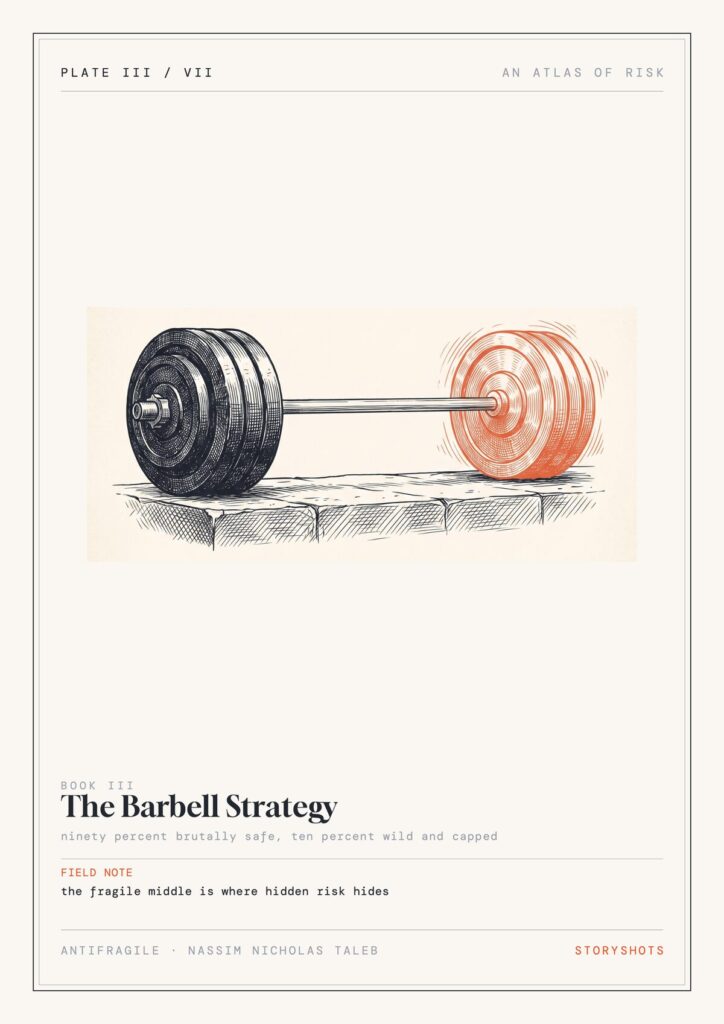
The strategy you can copy onto a napkin is the barbell. Put roughly ninety percent of your resources in boring, ultra-safe places. Put the remaining ten percent into wild bets with unlimited upside. Avoid the middle entirely, because the respectable medium-risk zone is where hidden blowups live. With a barbell, the worst case is a known, survivable loss, and the best case has no ceiling. This is a life shape rather than a stock tip. A stable day job plus ferocious creative work on weekends counts. If you cannot name the most something can lose you, you are standing in the middle.
Anything that has more upside than downside from random events is antifragile; the reverse is fragile.
The barbell holds your losses. The next idea multiplies your wins, and it starts with an olive press.
StoryShot #6: Why Tinkering Beats Planning
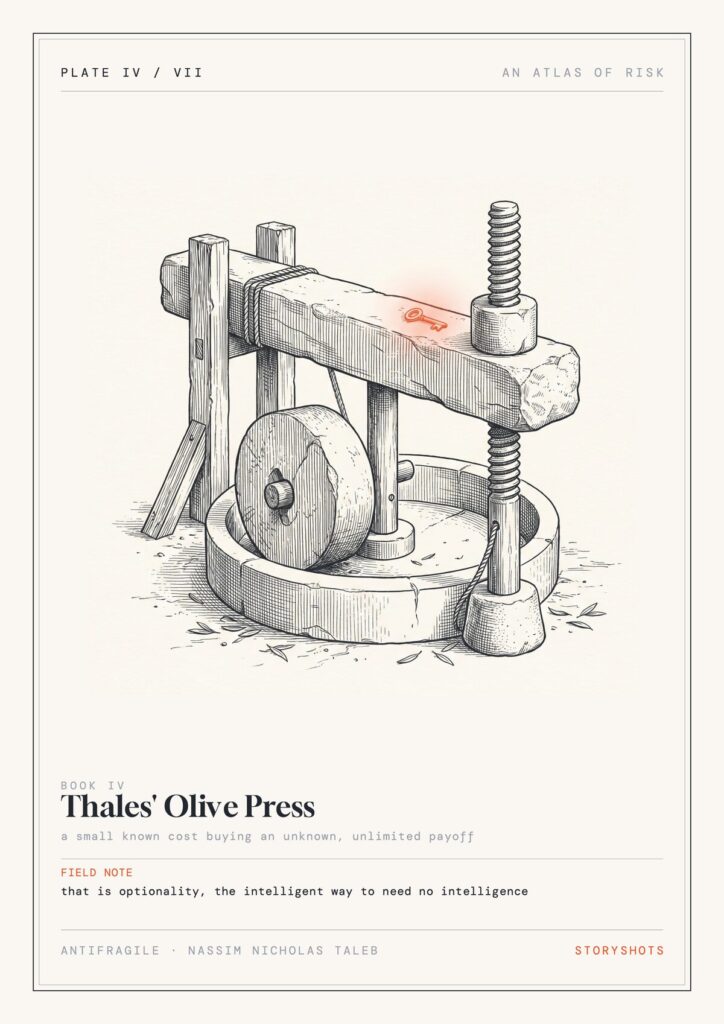
Thales of Miletus, tired of hearing that thinkers stay poor, put small deposits on the right to use every olive press in the region. The harvest boomed and he rented the presses out at his own price. He had invented the option: a small known cost buying an unknown, unlimited payoff. That is optionality, and it is the intelligent way to need no intelligence. With the right asymmetry you do not have to be right often. You only have to be exposed when luck arrives.
Now the part most people get wrong. One of the most successful green lumber traders in the business thought green lumber meant wood painted green. It means freshly cut wood. He misunderstood his own product completely and got rich anyway, because the knowledge that mattered was how the price moved. Educated competitors who knew the encyclopedia went broke around him. The knowledge that sounds impressive and the knowledge that pays are often different knowledge. Run cheap experiments with capped losses instead of grand plans, and start one before Friday.
Let me be more aggressive: we are largely better at doing than we are at thinking, thanks to antifragility.
Adding bets is one path. The stranger path is subtraction, and it predicts the future on the side.
StoryShot #7: Via Negativa and the Lindy Effect
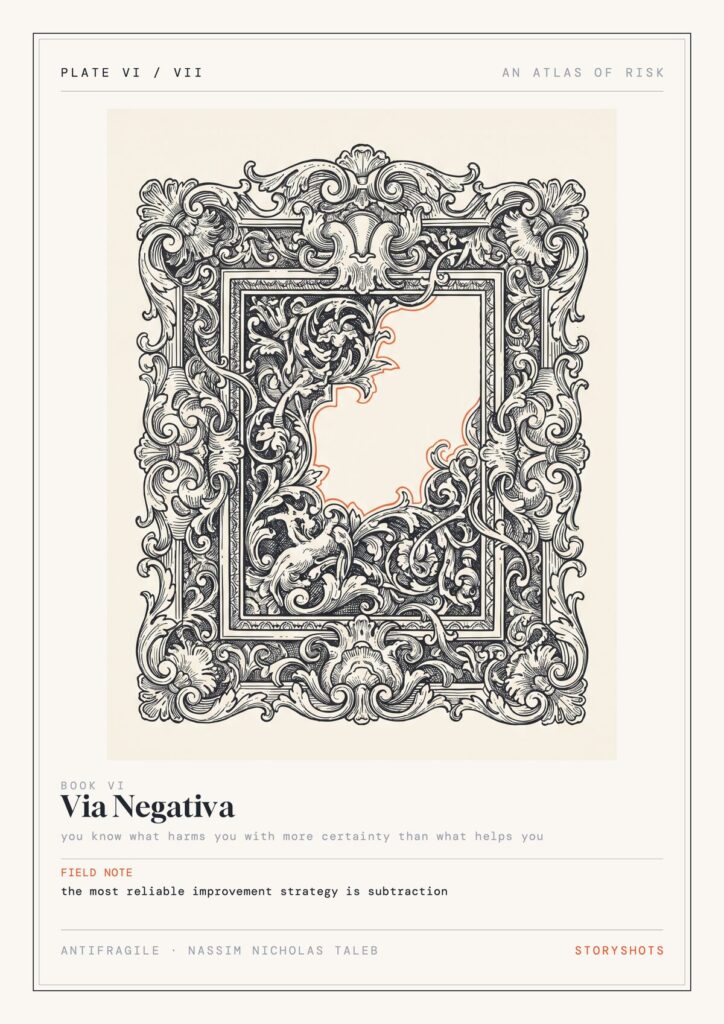
You usually know what is harming you with far more certainty than you know what might help you. The harms, like smoking or debt, are knowable. The helps are guesses. So the most reliable improvement strategy in existence is subtraction. The book’s name for it is via negativa, the way of removal. Nobody advertises it because every removal is a sale that did not happen.
Removal even tells the future. For perishable things like bodies, every year of age subtracts from life expectancy. For nonperishable things like ideas and technologies, every year survived adds to it. “If a book has been in print forty years, expect another forty years.” The chair has outlived ten thousand gadgets and will outlive ten thousand more. The itch for whatever launched this morning is a tax paid by people who confuse novelty with progress. Tonight, write down the three things you already know are harming you, and notice that improvement requires no new information.
The simpler, the better. Complications lead to multiplicative chains of unanticipated effects.
Subtraction keeps your own life honest. Keeping the experts honest took a law carved four thousand years ago, and it is where everything in this summary has been heading.
StoryShot #8: What Skin in the Game Really Means
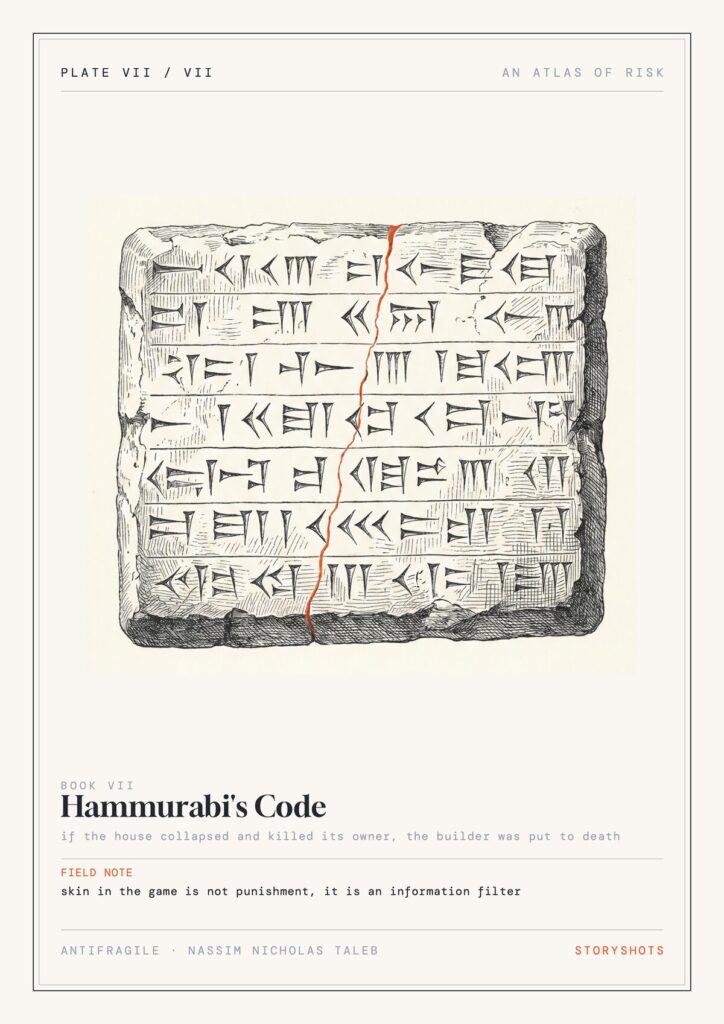
Hammurabi’s code, the oldest legal text we have, ruled that if a house collapsed and killed its owner, the builder was put to death. Brutal, yes. But look at what it understood. The builder knows the hidden weaknesses of his house better than any inspector ever could. The only way to drag that knowledge into daylight is to make him eat the downside. Skin in the game is not about punishment. It is an information filter, and it is the oldest one we have.
Modernity runs the scheme in reverse. The banker keeps bonuses from the good years while taxpayers absorb the crash. The pundit forecasts boldly, is wrong at no cost, and forecasts again next week. That is the transfer of fragility: harvesting the upside of volatility while handing the downside to someone who never agreed to hold it. The defenses are old-fashioned and immediately usable. Take advice only from people exposed to the consequences of that advice. Never ask for forecasts; look at what sits in the forecaster’s own portfolio. And tie your own advice to its outcome, even informally, and watch your confidence recalibrate toward honesty.
I want to live happily in a world I don’t understand.
That is the entire project in eleven words.
Someone in your life loves big ideas about risk. Sharing this summary is the small gift that starts a six-hour conversation.
Implementation Guide
Antifragile rewards readers who act the same week. Start with the triad audit: take a page and sort your income and your health into fragile, robust, or antifragile. Next, subtract. Remove the one habit you already know is harming you before adding anything new. Then build the barbell by moving your savings toward ninety percent boring and ten percent bold, and delete everything in the middle. If money is tight, barbell your time instead. Open one option before Friday: start a cheap experiment with capped cost and open upside. Finally, audit your advisors. Ask any expert you pay what they would do in your place, then check what happens to them if you lose. If they win when you lose, walk away.
Review and Criticism
The criticisms are real, so take them first. New York Times critic Michiko Kakutani found the book maddening and “self-congratulatory”, and long stretches of swagger do test your patience. Readers of The Black Swan will recognize recycled themes. Yet the toolkit underneath, from the triad through the barbell to via negativa, has aged better than almost anything else its decade produced, and the recycled themes arrive sharpened into instruments you can use. We rate it 4.1 out of 5.
Final Summary
This Antifragile summary traced the single idea Nassim Nicholas Taleb threads through every chapter. Shocks cannot be predicted, so build a life that gains from them. Stress feeds everything organic. When forecasting fails, the barbell and optionality take its place, and skin in the game keeps the players honest. So here is the forward-looking question: which move will you make first, the barbell or the subtraction? The full book holds treasures this summary buried on purpose. A streetwise trader debates Socrates for a full chapter, and the argument will test which kind of knowledge you really trust. A detection method the book calls the philosopher’s stone can spot hidden fragility in a bank or a diet before the blowup. The complete chapter-by-chapter deep dive of all seven books is waiting on the StoryShots app. The full book belongs with anyone who manages risk for a living, and anyone raising a child in a padded world. If this summary of Antifragile earned its minutes, the StoryShots app is the place to go for more on the book. Think of it as a friend passing along a battered copy worth keeping.
Rating
We rate Antifragile 4.1/5. How would you rate Nassim Nicholas Taleb’s book based on our summary?
PDF, Free Audiobook, Infographic, and Animated Book Summary
This was the tip of the iceberg. To dive into the details and support Nassim Nicholas Taleb, order it here or get the audiobook for free.
Did you like what you learned here? Share to show you care and let us know by contacting our support.
New to StoryShots? Get the PDF, audiobook and animated versions of this summary of Antifragile: Things That Gain from Disorder and hundreds of other bestselling nonfiction books in our free top-ranking app. It’s been featured by Apple, The Guardian, The UN, and Google as one of the world’s best reading and learning apps.
Related Book Summaries
- The Intelligent Investor by Benjamin Graham
- The Black Swan by Nassim Nicholas Taleb
- The Shallows by Nicholas Carr
- The Snowball by Alice Schroeder
- Everything Is F*cked by Mark Manson
- Can’t Hurt Me by David Goggins
- The Alchemist by Paulo Coelho
- Ikigai by Héctor García and Frances Miralles


 EN
EN  PT
PT  ES
ES  JA
JA  DE
DE  FR
FR  TR
TR  IT
IT  AR
AR  PL
PL  UK
UK  SV
SV  NL
NL  KO
KO
Fantastic explanations
We’re glad you like our content, Zubair. Thanks a ton for your heart-warming comment!